YouTube changed what a view means
A 95% growth claim on our own homepage is a good place to start.

The “+95% views” on our homepage came from a fairly careful comparison. We took The Masoom Minawala Show’s long-form catalogue, excluded Shorts and personal uploads, and compared 1 January to 3 September in 2025 and 2026. Views went from 2.39 million to 4.66 million. The calculation gives 94.8% growth.
We need to check what that growth measures.
On 24 August, near the end of our comparison period, YouTube changed its public view counter. A view now counts when a video starts playing, across long-form videos and live streams as well as Shorts. The earlier measure remains available as engaged views.
Our export has a column called “views.” That was enough to do the arithmetic. It isn't enough to settle whether we're comparing the same measurement across both years. YouTube's own API documentation says that field's meaning depends on the report.
I work with these numbers for a living, and we still have a claim to go back and check.
YouTube mentions the sponsors
The announcement says the new counter will help creators “express their true scale and value to brand partners and sponsors.” It also says the change won't affect creators' earnings or eligibility for the Partner Program.
Those are two quite different conversations. A creator can put the new public count in a pitch to a brand, while YouTube continues to use separate qualifying measures for its own programme.
There is a reasonable case for counting starts. Creators should be able to see how often their videos begin playing, and using a consistent rule across formats makes that easier to follow. I would want access to the number too. But a sponsor may be trying to buy something further into the video: a product explanation, a recommendation, or enough time with the host to understand why they use it.
The first frame doesn't tell them whether any of that happened.
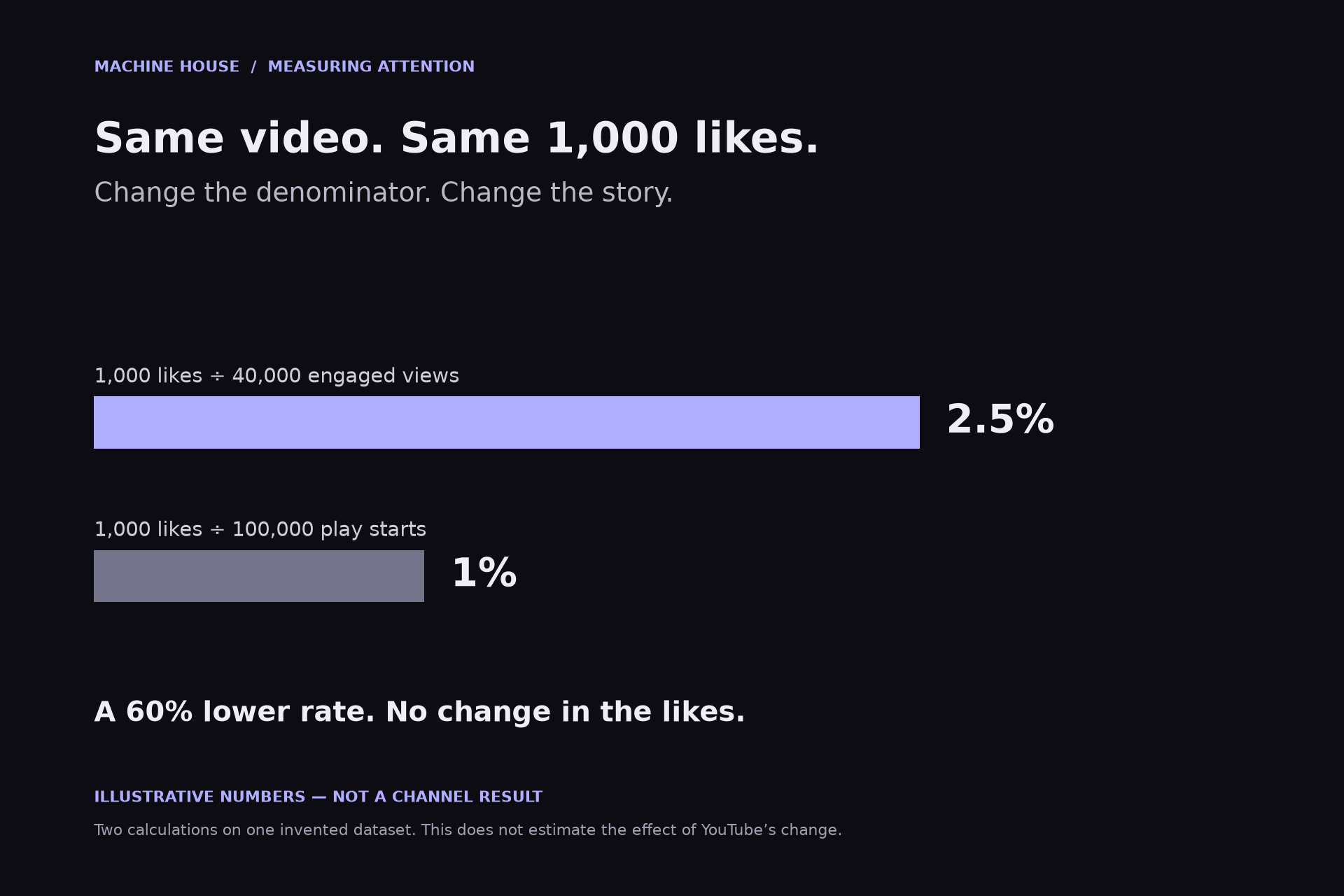
Suppose a video has 100,000 play starts, 40,000 engaged views and 1,000 likes. These are invented numbers for one video, not a before-and-after YouTube result. Divide the likes by engaged views and you get 2.5%; divide them by starts and you get 1%. Put the second rate next to the first in a report and the video appears to have become much less engaging.
Now use the same two counts to report a ₹1 lakh sponsorship. The fee works out to ₹2,500 per thousand engaged views or ₹1,000 per thousand starts. You could make a fairly cheerful slide about that saving. The sponsor paid the same amount for the same video.
The pitch can change faster than the work
The public counter is convenient because the creator and the brand can both see it. Explaining what happened after the video started usually takes more information from the creator. So there's a reason for the simplest available number to become the number people negotiate around, even when both sides know it leaves things out.
That puts an awkward choice in front of a creator. Lead with engaged views and a competitor's larger public count may look better. Lead with starts and you may be setting an expectation you'll later have to explain. The brand can also decide that a view is now easier to get and ask for more of them at the same fee. A higher counter doesn't settle who benefits from it.
We've had versions of this problem for years. Netflix calculates views by dividing hours watched by runtime. For a one-hour film, one person watching the whole thing and two people watching half each contribute the same amount. That's useful for comparing viewing volume. It would be a strange number to put beside YouTube playback starts and treat as a comparison of people reached.
But both can appear in a pitch under “views.” The definition tends to get less space than the number.
For our own claim, the next job is quite specific: check a comparable view series for both periods, rather than assume the field name guarantees it. “Engaged” needs care too; the API includes a click or tap to play in that definition, so it doesn't promise a substantial watch.
The revised homepage leads with the separately recorded watch-hour result: about 103% growth. The two view totals stay in the case study, with the unresolved comparison beside them.