Make the technology
matter to someone.
Machine House’s Scaler work connects technology research, editorial development and packaging. One episode makes the decisions visible: a video about the future of software, presented through a handwritten shop ledger.

Start with what changes for the viewer.
“Software 3.0” could have become an explanation of a technology term, a prediction about startups, or a story about the viewer’s career. Our July 8, 2026 idea brief chose the last of those as the way into the subject: what changes for an Indian developer when software becomes easier to build?
The brief kept the question of whether software startups would survive inside the episode. Leading with that question would have made the company’s future the main concern. Leading with the developer gave the viewer a decision to think about: which part of their work would still be valuable?
Rishwajeet developed the premise and locked the title and thumbnail direction. A team member supplied this episode’s script; the wider Machine House engagement includes research, scripts, production briefs, packaging and review.
Give the career question a specific promise.
The final title was The Next Million Dollar Software Job Isn’t Coding, locked on August 6 and published on August 11. It gives the viewer a familiar ambition, then leaves the job itself unresolved.
| Working direction | The editorial choice |
|---|---|
| Software Startups Are Dead. Build Anyway. | Put startup survival in the foreground. The brief wanted the developer’s own future to lead. |
| Code Is Free Now. You Aren’t. | Compressed the idea into a two-part line, but left the viewer to work out what they would learn. |
| The Next Million Dollar Software Job Isn’t Coding | Asked which work could become valuable, giving the episode a question to answer. |
These were development choices. The unused titles are not verified A/B test variants, and the published view count cannot tell us which alternative would have performed best.
Put the answer in a shop.
The packaging notes initially explored images about checking AI-generated code. That would have pointed toward code review as the answer. The script’s more ambitious career argument concerned understanding an industry’s problems well enough to build software around them.
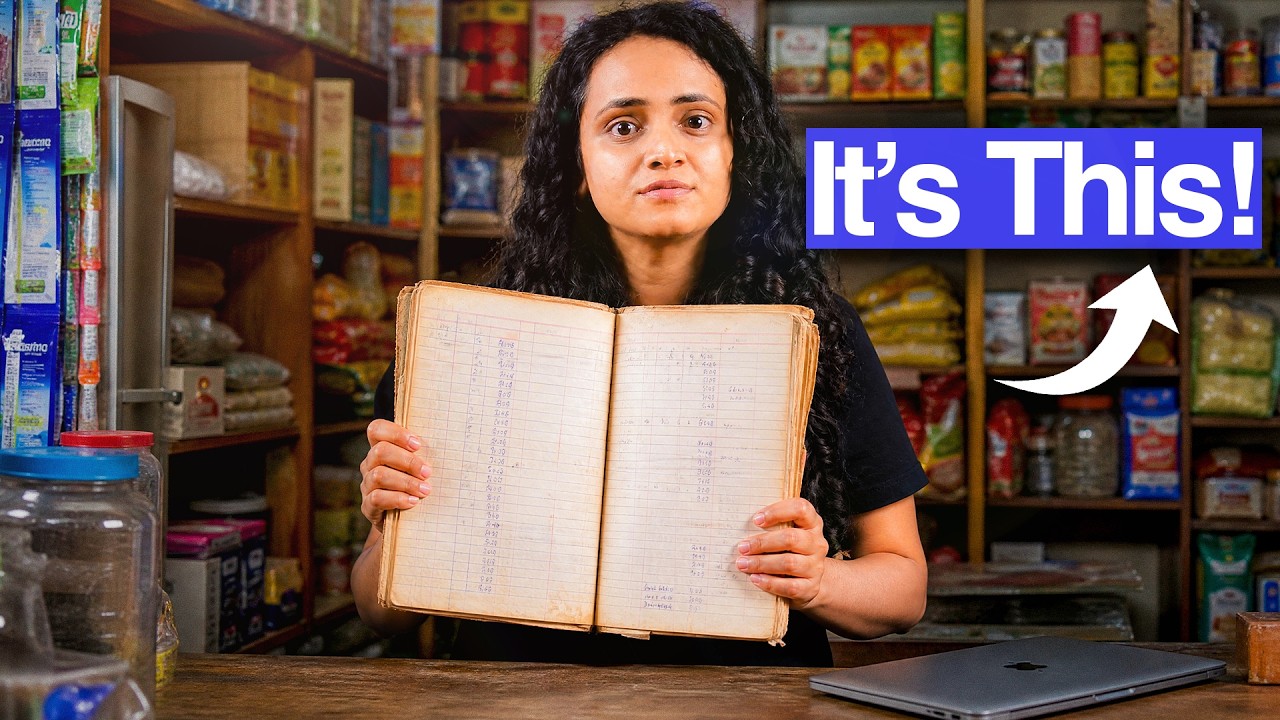
The brief moved the presenter behind a kirana-shop counter, holding an open bahi khata, the handwritten account book. The laptop stayed closed beside him. The ledger gave the viewer something concrete to connect to the software job in the title: the work a business still handles by hand.
Even the clothes affected the meaning. A shopkeeper outfit risked suggesting that the new career was running a shop. The black T-shirt kept the presenter looking like an engineer who had stepped behind the counter to understand the work.
Check that the episode delivers the answer.
At about 10:13 in the published video, the presenter develops the argument for vertical agents: software built around the needs of a particular industry. He puts the value in knowing where the work hurts and understanding the problem well enough to own it.
That passage explains the choice of image. A code-review scene would have directed the viewer toward checking a machine’s output. The shop places the engineer beside the person whose problem needs solving.
You can watch the rest of the releases on Scaler’s official channel. For its courses and admissions, visit Scaler.
Read the slate.
Keep the premise in view.
We reviewed 17 releases alongside their editorial origins, packaging and audience response. The review combined public performance histories with available Studio data and 146 comments across six leading videos.
150K+ views.
Seventeen releases we can point to.
| Selected release | Published | Public views |
|---|---|---|
| The Next Million Dollar Software Job Isn’t Coding | 11 August 2026 | 91,178 |
| OpenAI Keeps Killing Its Customers’ Startups | 20 August 2026 | 18,841 |
| India Has Zero Frontier AI Models. Here’s Why | 22 August 2026 | 16,012 |
The 17 videos we worked on for Scaler were published between 3 July and 24 August 2026. On 7 September they had 150,373 public views between them, an average of 8,845 per video. The three releases above accounted for 126,031 of those views (83.8%). The median video had 877.
What did the same videos look like at four weeks?
The oldest release had 66 days to accumulate views by 7 September. The newest had 14. To give them the same window, we looked up each video’s public count on the calendar date four weeks after publication. The median was 867 views, and the same three videos accounted for 84.7% of the total.
Those four-week readings span 31 July to 21 September. On 24 August, YouTube began counting a long-form view from the first frame of playback. The figures mix the two counting rules. To compare engaged viewing, or to separate paid and organic traffic, you’d need the channel’s Analytics. The counts alone can’t tell us how much difference a particular title or thumbnail made. YouTube explains the counting change.
Compare all 17 releases
Download the 17 rows for a spreadsheet, including the video links, publication dates and capture times. Each four-week count uses our first reading on that date in UTC.
Would the first day have picked the same film?
Rank the eleven Scaler films we could compare from September 2026 by their first public reading near the one-day mark and the AI bubble essay leads with 9,749. Our film about India’s railway booking site, IRCTC, sits fourth with 6,913. By the end of the first week the railway film had reached 404,402. Four weeks after publication, its counter read 569,465. The AI bubble film was second at 19,728.
Two episodes of the same weekly AI roundup also switched places. The September 14 edition started ahead, with 9,086 views against 6,076 for the September 22 edition. A week in, the later episode had passed it. At four weeks they stood at 11,961 and 13,092 respectively. The essay about Apple’s AI strategy stayed last at all three readings, moving from 2,068 views to 3,035.
Compare the eleven films at all three ages
The films are ordered by their first reading. Each column gives cumulative public views.
| September release | About 1 day | About 7 days | About 28 days |
|---|---|---|---|
| The AI bubble | 9,749 | 17,256 | 19,728 |
| Weekly AI roundup · September 14 | 9,086 | 11,542 | 11,961 |
| The one-crore engineer | 7,369 | 12,285 | 13,403 |
| India’s railway booking site | 6,913 | 404,402 | 569,465 |
| The Meta Muse launch | 6,662 | 12,689 | 12,848 |
| Weekly AI roundup · September 22 | 6,076 | 12,759 | 13,092 |
| Three skills for a software career | 5,104 | 12,482 | 12,867 |
| AI civilisations at OpenAI | 4,444 | 9,324 | 9,524 |
| Hiring managers and the software job market | 3,436 | 6,726 | 7,133 |
| Five new AI jobs | 2,571 | 6,416 | 6,809 |
| Apple’s AI race | 2,068 | 2,924 | 3,035 |
How we counted. We started with the 13 distinct long-form Scaler videos on our September work roster. We counted the surviving copy of one re-upload once and used the nearest public observation within three hours of each target age. Two films lacked a reading close enough to include. The first readings landed between 21 and 24 hours after publication. Download the 33 readings with video links, titles and exact times.
Six of the eleven films changed rank between the first and last readings. To decide which subject deserves a follow-up, look at where the later viewers came from and what held their attention. Ask the channel owner whether search, recommendations or a paid campaign supplied the extra views. That answer changes the case for making a sequel. Compare releases at the same age in YouTube Studio.
Why the Zerodha cover says “stay small”.
A trader opens Zerodha and sees zero open positions. Where did the trades go? That was the question behind one of our thumbnail ideas. It belonged with a title about trust.
For Scaler’s November 14 film about the 35 engineers behind Zerodha’s trading platform, we recommended the designer’s miniature blue office. Six people sit at their desks. The words beside them are “built to stay small”. The title gives the headcount. “Stay” asks what the engineers do when the workload grows.
At 6:37 in the film, the presenter takes one job the team had to finish before the market opened again. Every customer who traded needed a signed account of the day’s transactions. Sending those notes used to take seven to eight hours. In their account of the 2024 rewrite, Zerodha engineers Sarat Chandra and Karan Sharma explain how they split the work across servers, sent more than 1.5 million PDFs in about 25 minutes and shut the servers down when the job was done.
Questions about the work.
What work does Machine House do for Scaler?
The work includes technology research, editorial development, scripts, visual and production briefs, packaging and review of the published slate.
Which videos are included in the 150K+ total?
The total covers 17 published releases verified against Machine House’s Scaler work record, released from 3 July to 24 August 2026. They had 150,373 cumulative public views on 7 September 2026.
Tell us what you want to make.
Tell us about the channel or idea, the team you have and where you need help. We’ll discuss the scope on a 30-minute call.
Book a 30-minute call rishwajeet@machinehouse.media