The work deserves
a way in.
YouTube packaging connects an idea to the person who might watch it. We develop titles and thumbnail directions around the audience, the story and the promise the video can actually deliver.
What should the viewer want to find out?
A viewer sees the title and thumbnail before any of the work inside the video. We decide which question, consequence or surprise to put there, and which part of that story the picture can tell at a glance.
We develop packaging alongside the premise and script, then check it against the finished work. The title, opening and episode need to agree on what the viewer will get. A beautiful image cannot repair an idea that has no reason to exist.
What the engagement covers.
- A review of the channel’s existing packages, audience and available performance context.
- Distinct title directions, each with an editorial reason behind it.
- Thumbnail concepts, reference direction and a brief a designer can execute.
- Review of the title and image as a pair, including what is legible at feed size.
- Testing and interpretation where the channel and video are eligible, followed by the next packaging decision.
Rishwajeet stays involved in the creative call. Production can run with your designer or our team, depending on the scope.
What does the designer get?
Scaler’s video was called The Next Million Dollar Software Job Isn’t Coding. Our first thumbnail ideas showed somebody checking AI-generated code. A designer could have made a great picture from that brief. It would have sold the wrong job.
What we asked the designer to show. Put the engineer behind a kirana-shop counter, in the same black T-shirt she wears as a presenter. Have her hold an open bahi khata, the shop’s handwritten account book. Keep the closed laptop in the frame. The viewer who clicked to find out what an engineer could do besides write code would see someone learning how a shop does its accounts.
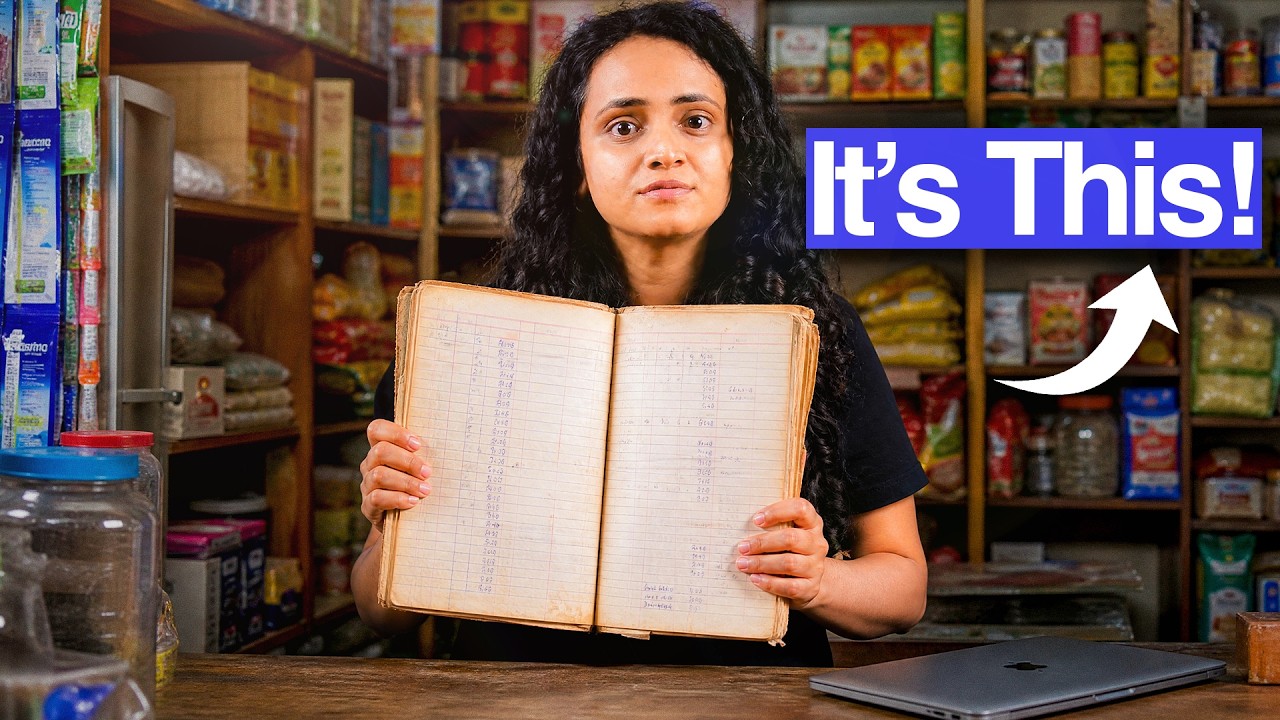
What changed in the artwork. The brief put the words on the left, with an arrow pointing into the ledger. In the published image the words sit on the right and the arrow points up at them. The ledger still fills the presenter’s hands. Cropping it out to make her face bigger would have cost the picture its answer.
Download the thumbnail brief for a worked example and a blank version for your designer. If you’re comparing proposals, ask who writes the brief, who makes the artwork and who reviews the title beside the finished image. Those can be three different people.
Three titles. A measurable difference.
In Rishwajeet’s June 2026 account of a packaging test, three title variants were compared on the same video:
| Title | Reported watch-time share |
|---|---|
| India’s IT Dream Is Falling Apart (Here's What's Next) | 32.1% |
| Why India’s IT Dream Is Falling Apart | 28.8% |
| The Indian IT Dream is Dead (Here's What's Next) | 39.2% — winning variant |
The creative interpretation was that “dead” gave the story a stronger sense of finality. The winning variant led the first by 7.1 percentage points of watch-time share. That is the result of this test; it is not a measured 7.1% increase in total video views, and it does not mean the same word wins for every subject.
The thumbnail made the argument visually: a gravestone, a marigold garland and the tricolour. Those choices made an Indian story recognizable at a glance. See the public test report and the film those titles introduced.
Test a creative hypothesis.
Start with the decision you owe the designer. On Masoom’s show, we repeated a title phrase on Samantha Ruth Prabhu’s thumbnail so it would carry even if someone only glanced at the image. If you wanted to test that choice, you could keep the title and portraits fixed and vary the words on the image. If you changed the title too, the result would help you choose which pair to publish. The effect of the repeated phrase would still be an open question.
YouTube’s native tool supports up to three titles, thumbnails or paired combinations on eligible videos. It evaluates results using watch time and can report no clear winner. We keep the test’s actual verdict in the review. YouTube’s A/B testing guidance.
The opening must keep the promise.
Packaging is part of the full viewing experience. Once someone clicks, the opening has to establish the situation, stakes and reason to keep watching. That is why a packaging engagement often connects to strategy and script reviews.
After publication we look at the result in context: the test, audience response, traffic and the video itself. The useful finding returns to the next idea and package. See how that operates across The Masoom Minawala Show.
Questions about the work.
Do you design thumbnails or just advise on them?
The scope can include strategy, title development, thumbnail concepts, designer briefs, creative reviews and production with our team. We can also work with your existing designer.
Can you improve packaging for already published videos?
Yes. We can review existing videos, develop stronger packages and plan eligible tests. We first check that the new promise is supported by the actual video.
How do you judge a winning title or thumbnail?
We use the platform test’s actual result and review it alongside the creative hypothesis and audience context. Watch-time share, CTR and total views are different measurements and should not be treated as interchangeable.
Can packaging guarantee that a video goes viral?
No. Packaging earns attention for the idea, but the subject, audience, viewing experience and distribution all matter. We make a reasoned creative choice and learn from the result.
Tell us what you want to make.
Tell us about the channel or idea, the team you have and where you need help. We’ll discuss the scope on a 30-minute call.
Book a 30-minute call rishwajeet@machinehouse.media